This article may contain affiliate links. If you buy through them we may earn a commission at no extra cost to you.
Five pieces of equipment—adjustable dumbbells, resistance bands, a pull-up bar, a yoga mat, and one cardio option—cover 90% of what a beginner needs. Total cost: $310–$530. No machines, no dedicated room, no wasted money on gear you’ll outgrow in a month.
Adjustable Dumbbells: Your Foundation
Adjustable dumbbells replace 15–20 individual weights in a 2-foot footprint. A set that adjusts from 5 lbs to 50 lbs per hand covers every beginner lift—squats, presses, rows, curls—and keeps up with you for 12–18 months before you hit the ceiling.
Why adjustable over fixed?
- Save roughly 80% of the floor space a fixed rack requires.
- Swap weight in 3–5 seconds between sets.
- Cost $200–$400 for the full range; buying fixed dumbbells from 5 to 50 lbs runs $400+ and still takes a shelf.
Two dial systems dominate the market. Pin-selector (slide a pin to choose the plate count) is faster to adjust mid-workout. Dial-selector (twist the handle) is slightly more compact on the floor. Either works; pick based on your space. Read our full guide to adjustable dumbbells for model-by-model comparisons.
Resistance Bands: Versatility for $20
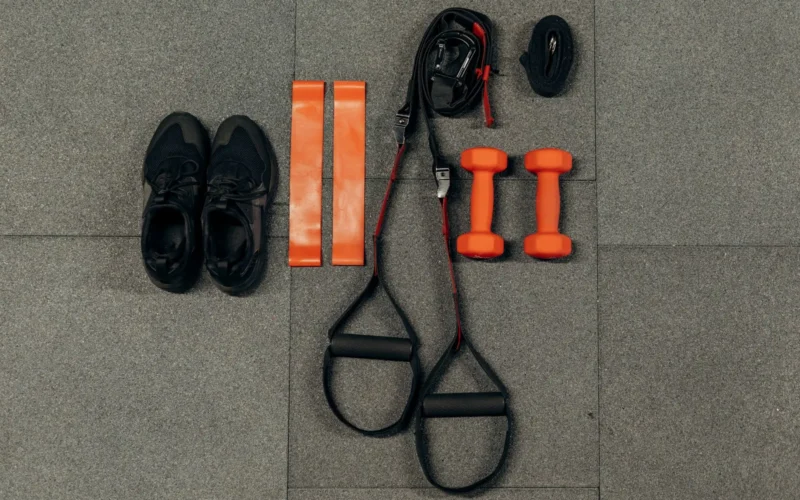
A five-pack of loop bands ($15–$30, under 1 lb total) adds assisted pull-ups, chest presses, leg work, and isolation moves without taking shelf space. You’ll reach for the heavy and medium bands about 80% of the time; the lighter ones earn their keep on shoulder rehab and warm-ups.
Loop vs. tube bands
- Loop bands: Continuous 41-inch circle. Best for lower-body work, assisted pull-ups, and stacking two bands when you need more resistance.
- Tube bands: Handles on each end. Better for upper-body pressing and pulling if looping a band around your wrists feels awkward.
Start with one loop set. Add tube bands only if you find yourself doing a lot of standing cable-style movements.
Pull-Up Bar: One Movement, Serious Return
A doorway pull-up bar costs $25–$60 and installs in 60 seconds—no drilling. Three sets of 3–5 pull-ups twice a week builds measurable back and arm strength in 4–6 weeks. Can’t do one yet? Loop a heavy resistance band over the bar and under your knees; it offloads 20–50 lbs depending on band thickness. Most people hit their first unassisted rep within 8–12 weeks of assisted training.
Installation and safety
- Doorway bars grip the frame with leverage—test them at 50% bodyweight before hanging full load.
- Confirm your door frame can handle at least 1.5× your bodyweight; older hollow-core frames sometimes can’t.
- Wall-mounted bars ($40–$100) require drilling but work on any stud wall and feel more solid under dynamic movement.
Yoga Mat: Cheap Insurance
A 6mm mat ($20–$40) protects your joints on floor work, muffles dumbbell noise, and gives you a defined training zone—which matters more than it sounds when you’re working out in a living room. Skip it once and your first set of planks on hardwood will remind you why it exists.
What to look for
- Thickness: 6mm cushions wrists and knees without making standing exercises feel unstable. Anything over 8mm gets spongy under weight.
- Material: PVC lasts years and costs $20–$30. Rubber or TPE ($30–$50) is quieter and more eco-friendly but tears faster under heavy dumbbells.
- Size: Standard 68″ × 24″ fits most floor work. If you’re over 6 feet tall, look for an 84″ option.
Cardio: Pick One and Commit
Beginners build the most visible fitness from 20–30 minutes of moderate cardio 2–3 times per week. You don’t need a machine to hit that—but if you want one, choose based on your body and space, not price alone.
Jump rope ($15–$40)
15 minutes at moderate pace burns 200+ calories and builds calf strength. Takes about 2 minutes to learn the basic bounce and 3–4 weeks to feel smooth. Zero storage footprint.
Stationary bike ($200–$600)
30 minutes at moderate effort burns roughly 250 calories. Low joint impact makes it the right call if your knees or ankles are sensitive. Needs about 10 sq ft of floor space.
Rowing machine ($300–$1,000)
Trains legs, back, and cardio simultaneously—efficient, but form breaks down fast when you’re tired. Budget 2–3 weeks to nail the drive sequence before pushing intensity. See our budget cardio guide for side-by-side comparisons.
Nice-to-Have: Ab Wheel and Foam Roller
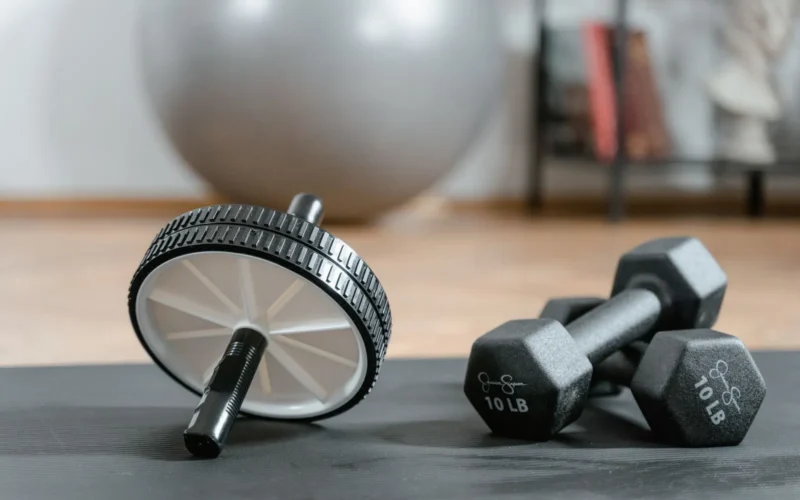
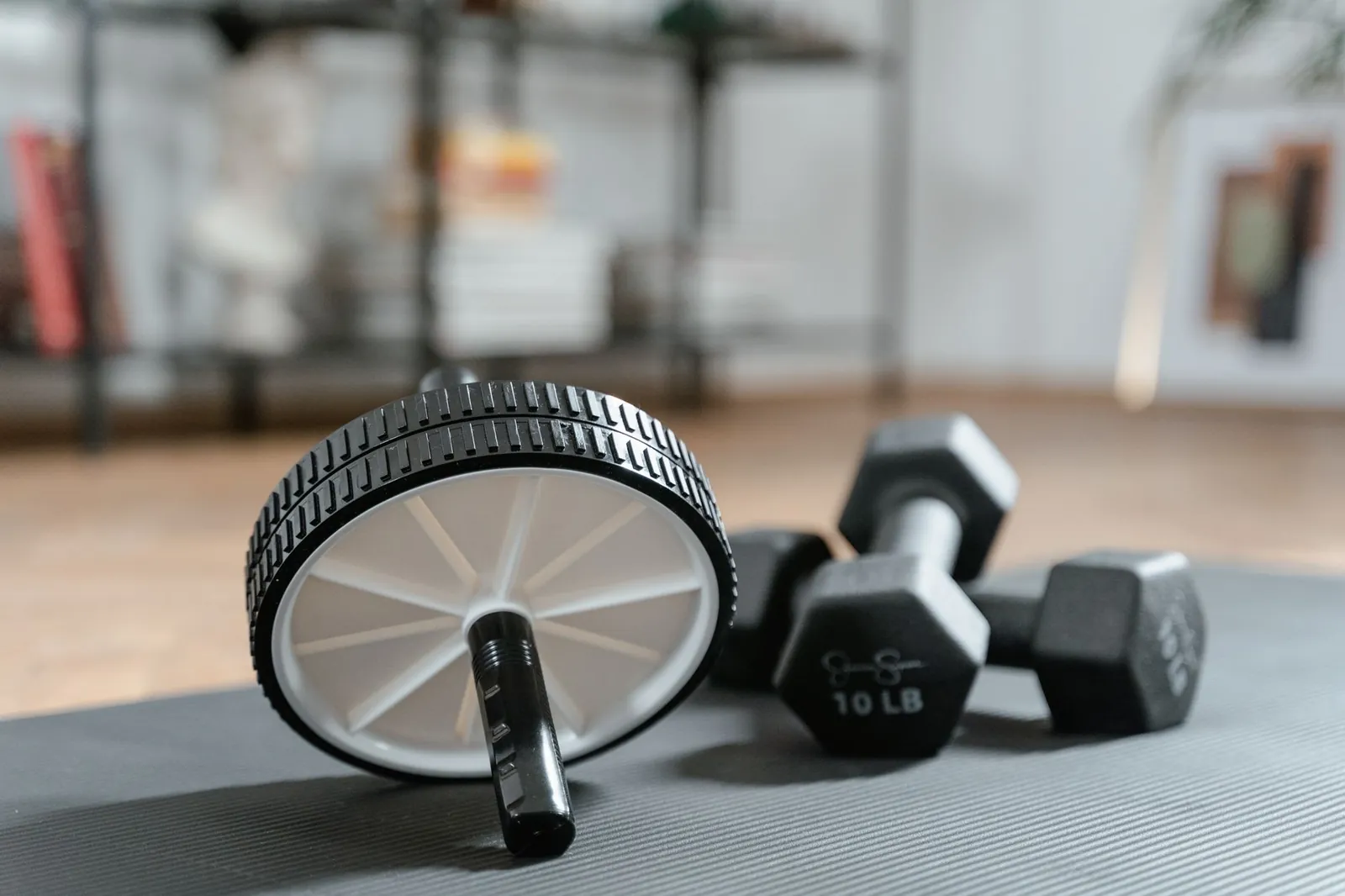
An ab wheel ($15–$25) is a single wheel with two handles. Roll out from kneeling, pause, roll back. It loads your core harder than most floor exercises in about 30 seconds of work—but start from your knees, not your feet, or you’ll strain your lower back.
A foam roller ($20–$50) won’t build strength, but 2–3 minutes of rolling after a workout reduces next-day soreness noticeably in the first 4–6 weeks when your body is adapting fastest.
Equipment Comparison: What to Buy First
| Equipment | Cost | Space | Priority | Best for |
|---|---|---|---|---|
| Adjustable dumbbells (5–50 lbs) | $250–$400 | 2 sq ft | 1st | Strength, all muscle groups |
| Resistance bands (set of 5) | $15–$30 | 0.1 sq ft | 2nd | Variety, assisted pull-ups |
| Pull-up bar | $25–$60 | 0 sq ft (wall/door) | 3rd | Back, arms, core |
| Yoga mat | $20–$40 | 25 sq ft (rolled out) | 4th | Floor work, joint comfort |
| Jump rope | $15–$40 | 0 sq ft | 5th | Quick cardio, calf work |
| Stationary bike | $200–$600 | 10 sq ft | 5th (alt) | Low-impact cardio |
| Ab wheel | $15–$25 | 0.1 sq ft | 6th | Core strength |
Our verdict
Start with adjustable dumbbells and resistance bands—$270–$430 and you’ve covered 90% of beginner strength training. Add a pull-up bar and mat when budget allows. Hold off on cardio equipment until you’ve built a consistent lifting habit; strength work drives faster early-stage body composition changes than cardio alone.
A beginner with dumbbells and consistency beats an advanced gym with excuses every single time.
How to Use This Gear: A Starter Framework
Three workouts per week, 30–45 minutes each. Each session: one main lift (squat, press, row, or deadlift variation), two or three accessory moves, and 10 minutes of easy cardio or stretching at the end.
Weeks 1–2: Start at 50% of the heaviest weight you think you can lift. Film a set or use a mirror—form errors are invisible when you’re focused on effort.
Weeks 3–4: Add 5–10 lbs per exercise when you complete all reps cleanly. Soreness drops; strength climbs. Both are signs the adaptation is working.
Weeks 5–8: Strength gains become obvious. This is when most people lock in consistency because the feedback loop—effort in, visible results out—finally feels real.
Budget Breakdown: Three Scenarios
Minimal ($100–$150)
- Adjustable dumbbells (5–30 lbs): $100–$120
- Resistance bands: $15–$30
Solid ($300–$400)
- Adjustable dumbbells (5–50 lbs): $250–$300
- Resistance bands: $20
- Pull-up bar: $40
- Yoga mat: $30
Complete ($500–$700)
- Adjustable dumbbells (5–50 lbs): $300
- Resistance bands: $25
- Pull-up bar: $50
- Yoga mat: $35
- Jump rope: $25
- Ab wheel: $20
- Foam roller: $40
Frequently asked questions
Do I need a barbell and rack as a beginner?
No. Dumbbells are safer to learn movement patterns with, need a fraction of the space, and drive the same strength gains in the first 3–6 months. Add a barbell only if you want to specialize in powerlifting-style squats, bench, or deadlifts. Most home gym users never need one.
How much space do I actually need?
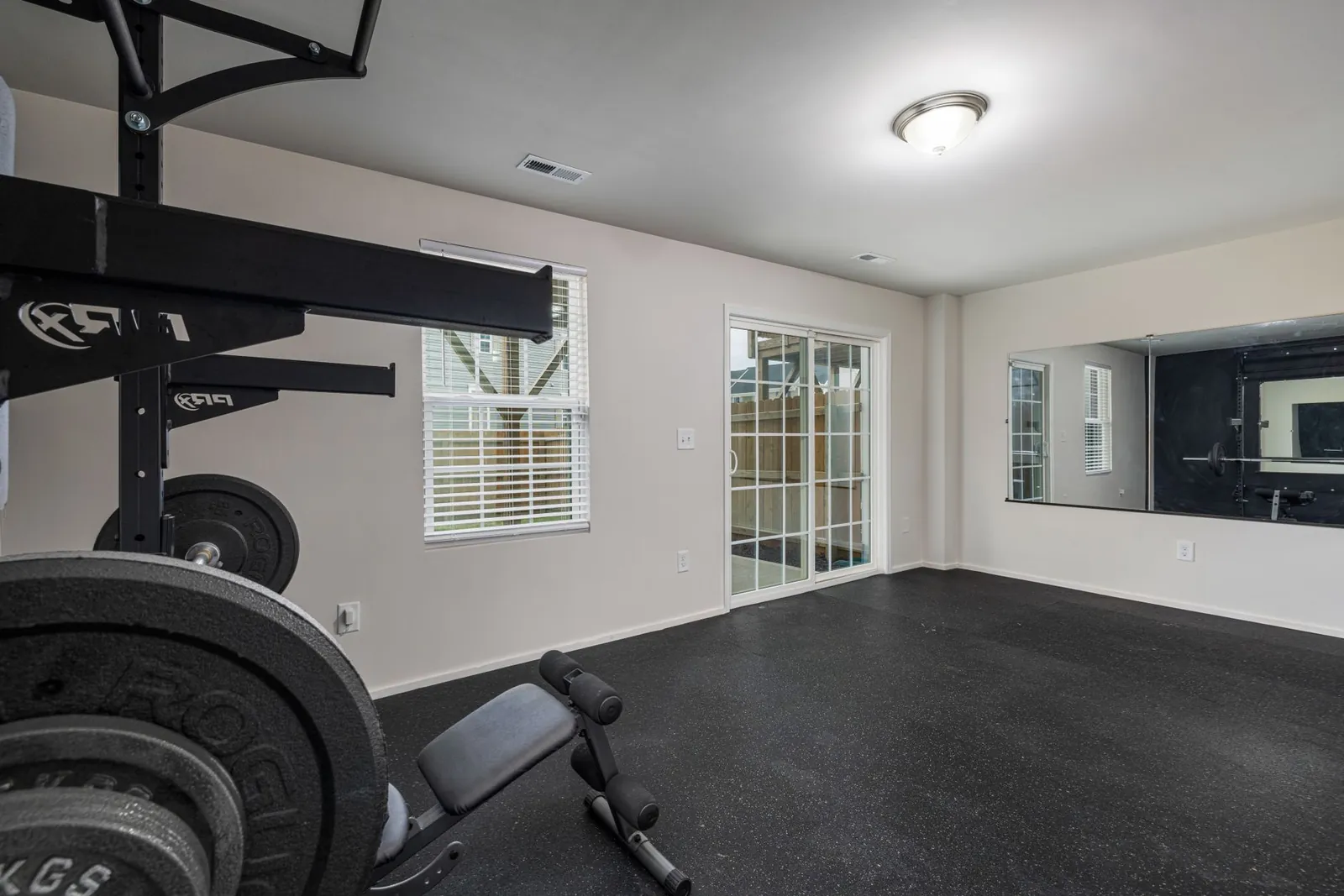
A 4 ft × 4 ft area handles dumbbells, bands, and all floor work. A doorway pull-up bar uses existing door frame space. A stationary bike or rowing machine needs roughly 8 ft × 3 ft. Start with the small footprint setup; you can expand once you know what you’ll actually use.
What if I can’t do a pull-up yet?
Loop a heavy resistance band over the bar and place it under your feet or knees. Depending on band thickness, this offloads 20–50 lbs of your bodyweight. Do 3 sets of 5 reps twice per week. Most people complete their first unassisted pull-up within 8–12 weeks.
Should I buy expensive branded gear or budget alternatives?
Budget brands hold up fine for dumbbells, bands, and mats. Spend more on your pull-up bar—cheap doorway models can slip or bend under dynamic movement—and any cardio machine, where low-cost bikes and rowers develop squeaks and mechanical failures within months. Check reviews for the specific model, not just the brand name.
Can I build muscle with just bodyweight and bands?
Yes, but progress stalls faster. Muscle growth responds best to progressive overload—adding weight over time—which dumbbells make straightforward and bands make harder to measure. Bands and bodyweight work well as supplements. As your primary tool, expect slower gains after the first 8–12 weeks.

Marcus is a cycling coach and hiker who plans routes down to the water stops.