This article may contain affiliate links. If you buy through them we may earn a commission at no extra cost to you.
An upper lower split gives you four training days per week—two upper, two lower—so each muscle group gets hit twice with 3 to 4 days of recovery between hard sessions. That frequency-to-recovery ratio beats once-a-week body-part splits for hypertrophy and outpaces full-body routines on total weekly volume per muscle.
What Is an Upper Lower Split?
You train upper body on days 1 and 3, lower body on days 2 and 4. A typical week runs Monday/Tuesday/Thursday/Friday, leaving Wednesday and the weekend as rest or conditioning days. Each session covers pressing, pulling, or hinging patterns—nothing gets buried for a week at a time.
Compared to push-pull-legs (6 days, 1× frequency per muscle) or full-body (3 days, lower volume per session), upper lower sits in a practical middle ground. You accumulate 10–20 working sets per muscle group per week—a range supported by most hypertrophy research—without the 90-minute sessions PPL often demands.

Why Upper Lower Splits Work
Frequency and recovery balance
Twice-weekly frequency lets you run higher total volume than once-per-week splits without compressing all that work into a single brutal session. Your quads, for example, get a strength day Tuesday and a hypertrophy day Friday—different rep ranges, different fatigue profiles, same muscle growing.
Built-in intensity variation
Run day 1 upper heavy (3–5 reps, 4–6 sets per compound) and day 3 upper moderate (6–10 reps, 3–4 sets). That rep-range rotation reduces joint stress and prevents the stagnation that comes from grinding the same scheme week after week.
Time efficiency
Each session runs 45 to 75 minutes. Strength days take longer because you rest 2–3 minutes between sets; hypertrophy days move faster at 90-second intervals. Either way, you’re done well inside an hour and a half.
Train each muscle group twice weekly with 3–4 days between hard sessions, and you’ll accumulate enough volume to grow without overtraining.
Sample Upper Lower Split Routine
Day 1: Upper Body (Strength Focus)
- Barbell bench press: 4 sets × 4–6 reps
- Bent-over barbell row: 4 sets × 4–6 reps
- Incline dumbbell press: 3 sets × 6–8 reps
- Seal rows or chest-supported rows: 3 sets × 6–8 reps
- Lateral raises: 3 sets × 10–12 reps
- Face pulls: 2 sets × 12–15 reps
Rest 2–3 minutes between heavy compound lifts, 60–90 seconds for accessories.
Day 2: Lower Body (Strength Focus)
- Back squat or front squat: 4 sets × 4–6 reps
- Deadlift or trap-bar deadlift: 4 sets × 4–6 reps
- Bulgarian split squats: 3 sets × 6–8 reps per leg
- Leg curls: 3 sets × 8–10 reps
- Calf raises: 3 sets × 12–15 reps
Rest 2–3 minutes between compound lifts. Squats and deadlifts in the same session are taxing—sequence them that order, not reversed.
Day 3: Upper Body (Hypertrophy Focus)
- Incline barbell or dumbbell bench: 4 sets × 6–8 reps
- Weighted pull-ups or lat pulldowns: 4 sets × 6–8 reps
- Machine chest press: 3 sets × 8–10 reps
- Seal rows or machine rows: 3 sets × 8–10 reps
- Lateral raises: 3 sets × 10–12 reps
- Bicep curls: 3 sets × 8–12 reps
- Tricep rope pushdowns: 3 sets × 10–12 reps
Rest 90 seconds to 2 minutes between sets.
Day 4: Lower Body (Hypertrophy Focus)
- Leg press or hack squat: 4 sets × 8–10 reps
- Romanian deadlifts: 4 sets × 8–10 reps
- Leg extensions: 3 sets × 10–12 reps
- Leg curls: 3 sets × 10–12 reps
- Walking lunges: 3 sets × 10 reps per leg
- Calf raises: 3 sets × 12–15 reps
Rest 90 seconds between sets. This day accumulates serious quad and hamstring volume—expect soreness if you’re new to the split.
How to Progress on an Upper Lower Split
Log every set. On your main compounds—squat, deadlift, bench, row—aim to add 1–2 reps or 2.5–5 lbs every 1 to 2 weeks. When you hit the top of your target range (say, 4×6 on bench) with solid form, add 5 lbs next session and work back up.
Accessories are simpler: add a rep or two each week, or bump the weight when you consistently hit the top of the range. Small jumps compound quickly over a 12-week block.
Deload every 4–6 weeks. Cut volume by 40–50% for one week—same exercises, same intensity, fewer sets. Your joints and nervous system recover; you return stronger.
Equipment and Gear Picks
The program’s core lifts require a barbell, squat rack, and bench. For accessories, a cable stack or set of dumbbells covers most variations.
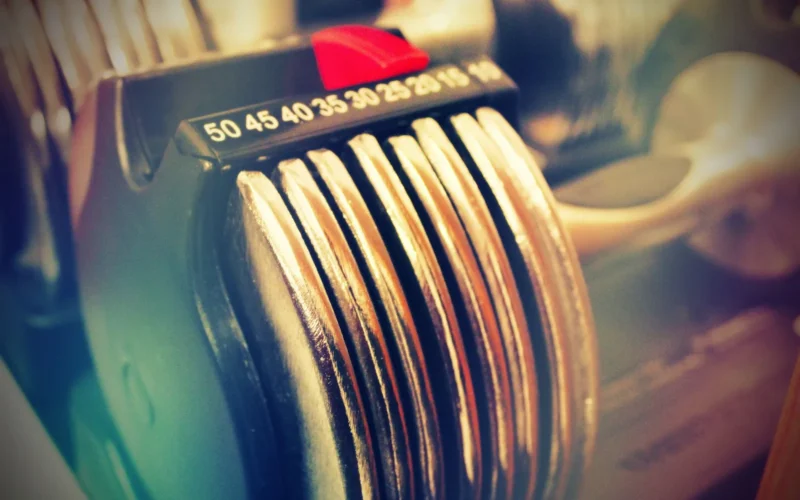
Best for home gyms: adjustable dumbbells (5–50 lbs) plus a power rack with a bench. You can run the full split with that setup, swapping barbell rows for dumbbell rows and leg press for goblet squats.
Best for commercial gyms: use barbells for compounds, machines for accessories. Cable rows, machine chest press, and leg curl machines add variety that keeps the program productive past the first 8 weeks. See our guide to the best adjustable dumbbells for home gyms if you’re building out a home setup.
Upper Lower vs. Other Splits
| Split Type | Days Per Week | Frequency Per Muscle | Best For |
|---|---|---|---|
| Full-Body | 3 | 1x per week | Beginners, busy schedules |
| Upper Lower | 4 | 2x per week | Intermediate lifters, balanced growth |
| Push-Pull-Legs | 6 | 1x per week | Advanced lifters, high volume tolerance |
| Upper Lower Upper | 5–6 | 2–3x per week | Advanced lifters, max strength focus |
Our verdict
Four days a week, twice-weekly frequency, sessions under 75 minutes—upper lower delivers a strong return on time invested. It’s the right next step if you’ve outgrown full-body 3-day programs and aren’t ready to commit to 6-day PPL. New to structured training? Start with full-body. Chasing maximum volume and have 6 days free? See our push pull legs splits guide—but budget 90 minutes per session.
Common Mistakes to Avoid
Skipping the warm-up
Five minutes on a cardio machine plus dynamic leg swings and shoulder circles costs you nothing and cuts injury risk on heavy compound sets. Cold squats are where knees get unhappy.
Ignoring weak points
If your bench lags, add one set of floor press or incline work on day 3. Imbalances don’t self-correct—they widen.
Progressing too fast
Adding 10 lbs to your squat every week works for about two weeks, then form breaks down. Cap compound jumps at 2.5–5 lbs per session and you’ll still add 60–120 lbs to your squat in a year.
Neglecting the posterior chain
Rows, pull-ups, and face pulls belong in every upper session—not as afterthoughts. Your rear delts and upper back protect your shoulders on every pressing movement you’ll ever do.
Nutrition and Recovery
To build muscle, eat 200–300 calories above your maintenance level and hit 0.7–1 gram of protein per pound of bodyweight daily. Carbohydrates fuel your lifting sessions directly—cutting them on training days will cost you reps on your compounds.
Sleep 7–9 hours. Four hard training days create real systemic demand. Chronic sleep under 6 hours measurably blunts muscle protein synthesis and tanks gym performance—no program fixes that.
Frequently asked questions
How long should each upper lower session take?
45 to 75 minutes, depending on your pace and rest times. Strength-focused days (4–6 rep ranges) take longer because you rest 2–3 minutes between sets. Hypertrophy days (6–12 reps) move faster at 90 seconds to 2 minutes rest.
Can I do upper lower 3 days a week instead of 4?
Yes, but you’ll hit each muscle group only once per week, which reduces weekly volume. This works fine for beginners but limits growth for intermediate lifters. If you’re short on time, a full-body 3-day routine is more efficient than a partial upper lower split.
Should I do cardio on an upper lower split?
Yes, but keep it light. 15–20 minutes of steady-state cardio (walking, cycling, rowing) on rest days or after lifting won’t interfere with recovery. High-intensity interval training (HIIT) more than twice a week can eat into strength gains.
What if I can’t do 4 days a week consistently?
A 3-day full-body routine is more forgiving. You can miss a day and still hit each muscle group once per week. Upper lower demands consistency; missing a session means a muscle group goes 8+ days without a hard stimulus.
How long should I run this program before switching?
Run it for 8–12 weeks minimum to see real progress. After 12–16 weeks, if you’ve hit a plateau on main lifts, rotate in new exercises or try a different rep scheme. Switching every 3–4 weeks is too frequent and wastes time learning new movements.

Marcus is a cycling coach and hiker who plans routes down to the water stops.