This article may contain affiliate links. If you buy through them we may earn a commission at no extra cost to you.
You can build real muscle with zero equipment. The mechanism is identical to lifting weights: force your muscles to work harder over time, eat enough protein, and recover. Bodyweight training gives you five ways to do that—and most people never use more than two.
Progressive Overload Is Non-Negotiable

Without weights, you have five levers: more reps, shorter rest between sets, slower tempo, harder exercise variations, and higher weekly frequency. Pull at least one lever every session.
Rep and Set Ranges
Target 8–15 reps per set for hypertrophy. Run 3–4 sets per exercise, hitting each muscle group 2–3 times per week. Once you hit 15 clean reps, either add 2–3 reps next session or move to a harder variation—whichever keeps form tight.
Tempo and Time Under Tension
Speed reps waste effort. A 3-second lower on a push-up or pull-up creates more muscle damage than rushing through 20 reps. Aim for 40–60 seconds of time under tension per set. Count: 3 seconds down, 1-second pause, 1 second up.
Exercise Progression
Master the basic version, then level up. Push-ups → diamond push-ups → archer push-ups → one-arm push-ups. Bodyweight rows → archer rows → one-arm rows. These ladders keep you challenged for 6–12 months before you need a single piece of equipment.
Master the Big Four Bodyweight Movements
These four movements cover most major muscle groups and scale from day-one beginner to advanced:
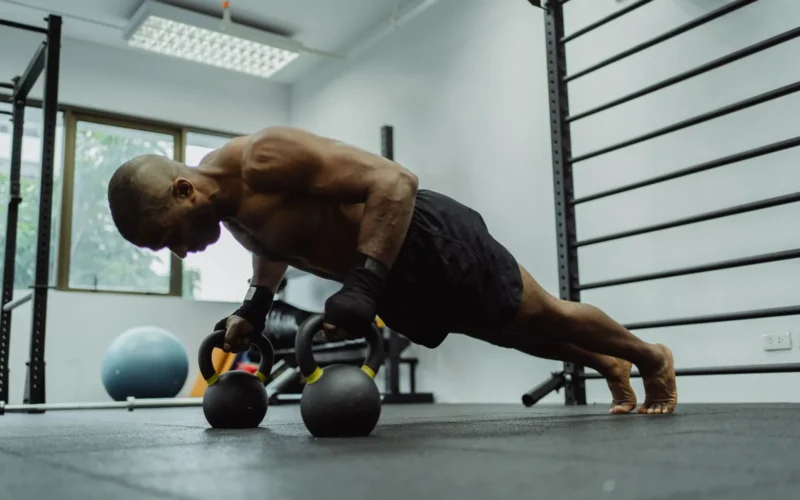
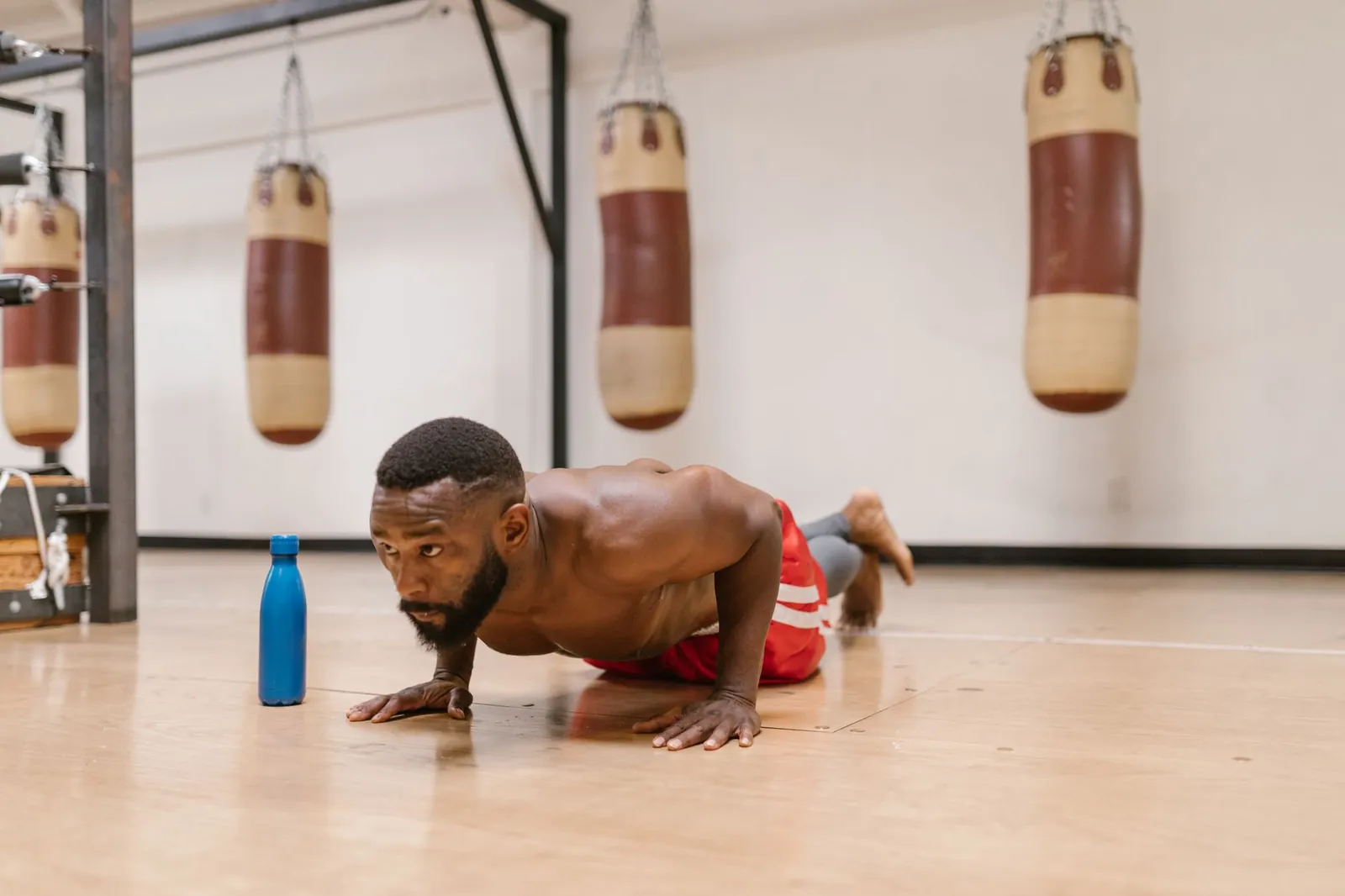
- Push-ups: chest, shoulders, triceps. Start incline (hands on a bench) if needed. Progress to archer, diamond, or pseudo-planche.
- Pull-ups or rows: back, biceps, rear delts. Use a door frame, tree branch, or sturdy table. Can’t do one pull-up? Do negatives—jump to the top and lower over 5 seconds, 3 sets of 3–5 reps. Bodyweight rows are easier and still effective.
- Squats: quads, glutes, hamstrings. Progress from bodyweight squats to Bulgarian split squats to pistol squat variations.
- Dips: triceps, chest, shoulders. A chair works. Easier entry: feet flat on the floor, hands on the chair seat behind you.
Muscle grows from progressive challenge and recovery, not from the tool you use—your body doesn’t know if the resistance is gravity or a barbell.
Build a Simple Full-Body Routine
Three days per week, non-consecutive. Each session runs 30–40 minutes.
Sample Workout (A/B Split)
Day A — Upper + Core:
- Push-ups: 4 sets × 8–12 reps
- Bodyweight rows: 4 sets × 8–12 reps
- Pike push-ups: 3 sets × 8–10 reps
- Dips: 3 sets × 6–10 reps
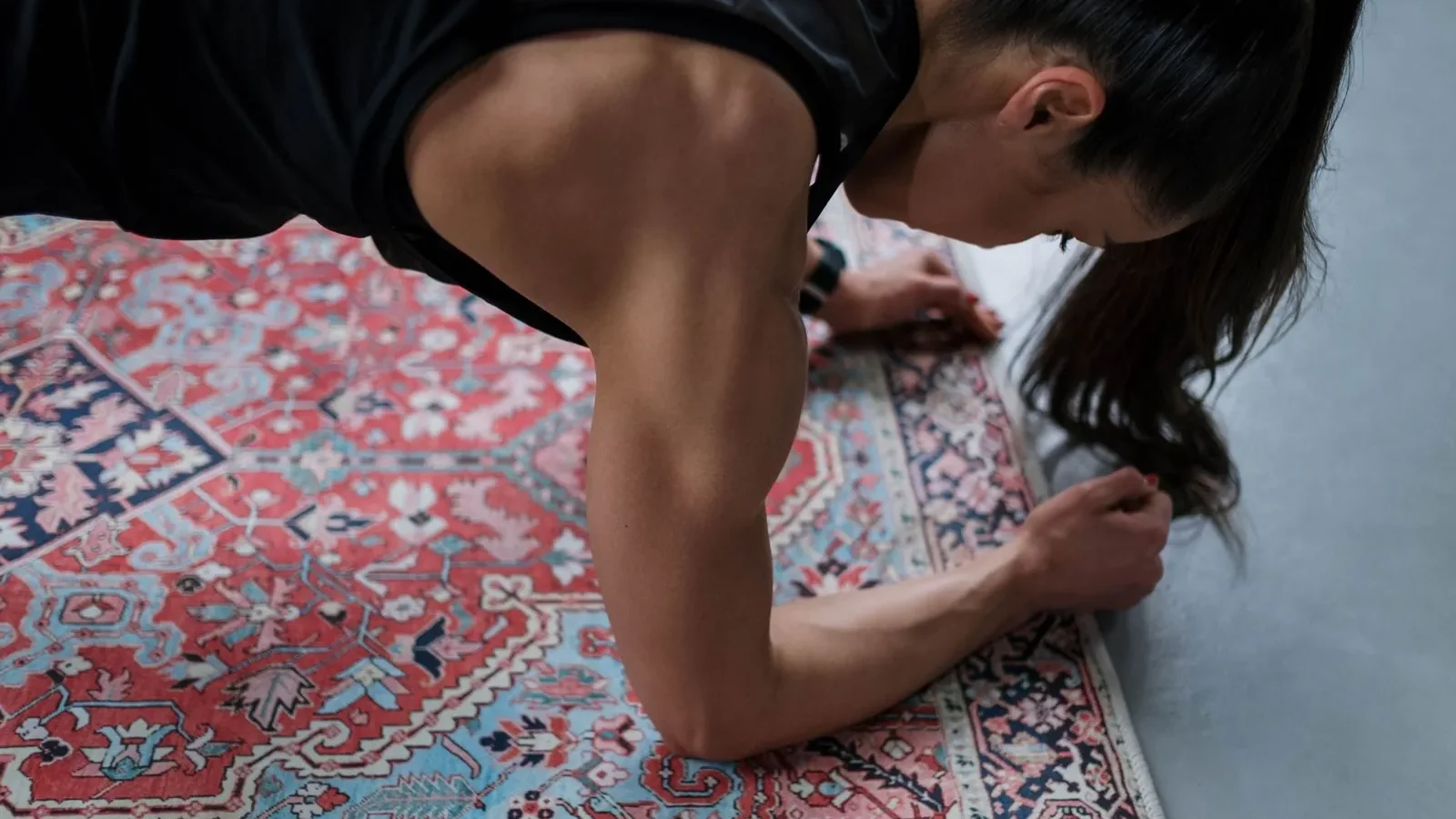
- Plank: 3 sets × 30–60 seconds
Day B — Lower + Core:
- Squats: 4 sets × 12–15 reps
- Bulgarian split squats: 3 sets × 10 reps per leg
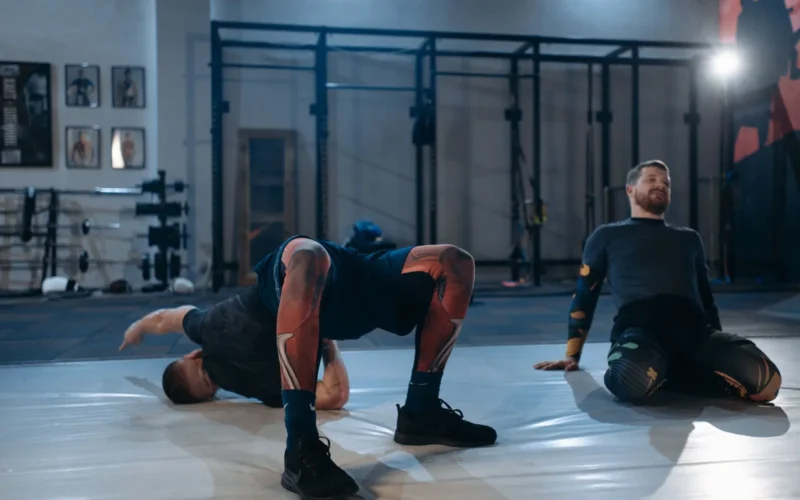
- Glute bridges: 3 sets × 12–15 reps
- Single-leg calf raises: 3 sets × 12 reps per leg
- Hollow body hold: 3 sets × 20–40 seconds
Alternate A and B each session. Rest at least one full day between workouts. This structure hits each muscle group roughly 1.5 times per week—enough stimulus for consistent growth.
Nutrition: You Can’t Build Muscle on Air
Bodyweight training removes the equipment barrier. Nutrition removes the next one.
Protein Target
Aim for 0.7–1 gram of protein per pound of bodyweight daily. At 180 pounds, that’s 125–180 grams. Spread it across 3–4 meals. Chicken, eggs, Greek yogurt, cottage cheese, canned tuna, and beans are cheap and hit those numbers without much planning.
Calories
Eat at maintenance or a 200–300 calorie surplus above your baseline. Too large a surplus and fat accumulates faster than muscle. Too steep a deficit and growth stalls regardless of training quality. Track for two weeks, then adjust based on scale weight and the mirror—not one or the other alone.
Hydration
Drink at least half your bodyweight in ounces of water daily (180 pounds = 90 oz minimum). Micronutrients matter less than total protein and calories, but consistent vegetables, fruit, and whole grains support recovery without requiring a spreadsheet.
Recovery Is Where Growth Happens
Training breaks tissue down. Sleep and rest days build it back up, slightly bigger. Skip recovery and you plateau—or get hurt.
- Sleep: 7–9 hours per night. Muscle protein synthesis peaks during deep sleep; cutting it short cuts your results.
- Rest days: At least 2–3 per week. Walking or light stretching is fine; it doesn’t count as a training day.
- Soreness: Expect delayed-onset muscle soreness (DOMS) in weeks 1–2. It fades. Light movement helps more than doing nothing.
- Injury risk: Sharp joint pain means stop. Muscle burn and fatigue are fine; wrist, elbow, or knee pain is not. This is not medical advice—if pain persists, see a professional.
Track Progress and Know When to Advance
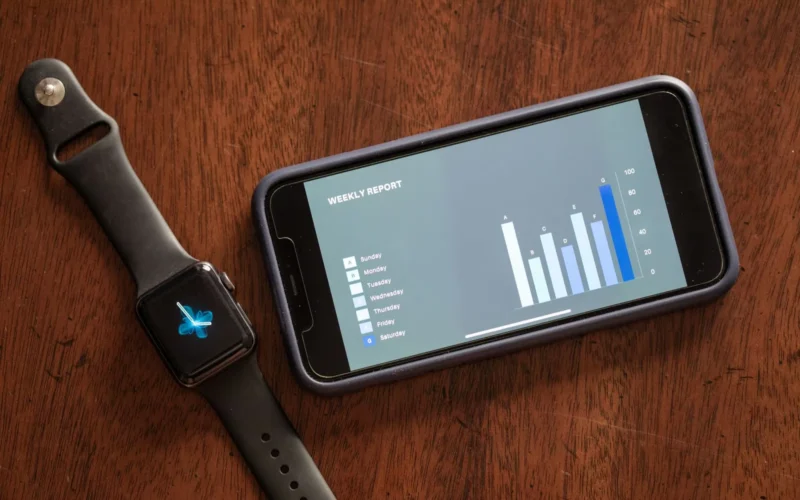
Write down every session: exercise, sets, reps, and a one-word note on how it felt. Every 2–4 weeks, try to add 1–2 reps or shift to a harder variation. Stuck at the same rep count for three consecutive weeks? Change the tempo, reduce rest, or move up the progression ladder.
Progress isn’t linear. Some weeks feel strong; others feel flat. Judge by the 4–8 week trend, not individual sessions.
Common Mistakes That Kill Progress
- Chasing rep counts instead of tension: 4 sets of 10 controlled push-ups beats one set of 50 sloppy ones for muscle growth.
- Skipping lower body: Your legs are roughly half your total muscle mass. Train them just as hard as your upper body.
- Form breakdown to hit a number: A clean 8 reps builds more muscle than 15 reps with a collapsing spine.
- Ignoring protein: Training without hitting your protein target is the single fastest way to leave gains on the table.
- One set per exercise: Research consistently points to 3–4 working sets per exercise as the minimum effective dose for hypertrophy.
When to Invest in Minimal Equipment
Bodyweight alone gets most people 12–18 months of consistent progress. When you plateau or want more variety, a pull-up bar ($25–$40), resistance bands ($15–$30), or a single adjustable dumbbell open up new progressions without a gym membership. Our guide to best home gym equipment for beginners covers exactly that. For now, lock in the fundamentals with bodyweight exercises for strength.
Frequently Asked Questions
Can you build as much muscle with bodyweight as with weights?
Yes, if you apply progressive overload. The stimulus comes from challenging your muscles, not the tool. Bodyweight has a ceiling—you can’t add infinite resistance—but it’s high enough for most people to build substantial muscle over 1–2 years before that ceiling becomes a real constraint.
How long until you see muscle growth?
Strength gains appear in 2–4 weeks as your nervous system adapts. Visible muscle growth takes 8–12 weeks of consistent training and adequate protein. Don’t expect a transformation at 30 days, but you will look and feel different by week 12.
What if I can’t do a single pull-up?
Start with negatives: jump to the top position and lower yourself over 5 seconds. Do 3 sets of 3–5 negatives, 2–3 times per week. Most people earn their first full pull-up within 4–6 weeks. Bodyweight rows under a table are also an effective alternative that’s easier to scale from day one.
Do I need to eat in a surplus to build muscle?
A small surplus (200–300 calories above maintenance) speeds growth, but beginners can build muscle at maintenance—sometimes called “newbie gains.” Hit your protein target (0.7–1g per pound of bodyweight) and let body composition shift gradually. The surplus matters more once you’ve trained consistently for 6+ months.
How often should I train each muscle group?
2 times per week per muscle group is the sweet spot for hypertrophy, though 1.5 times (as in a 3-day full-body split) still produces solid growth. An upper/lower split hits each muscle group twice. Both work—pick the schedule you’ll actually stick to for 8–12 weeks.

Marcus is a cycling coach and hiker who plans routes down to the water stops.